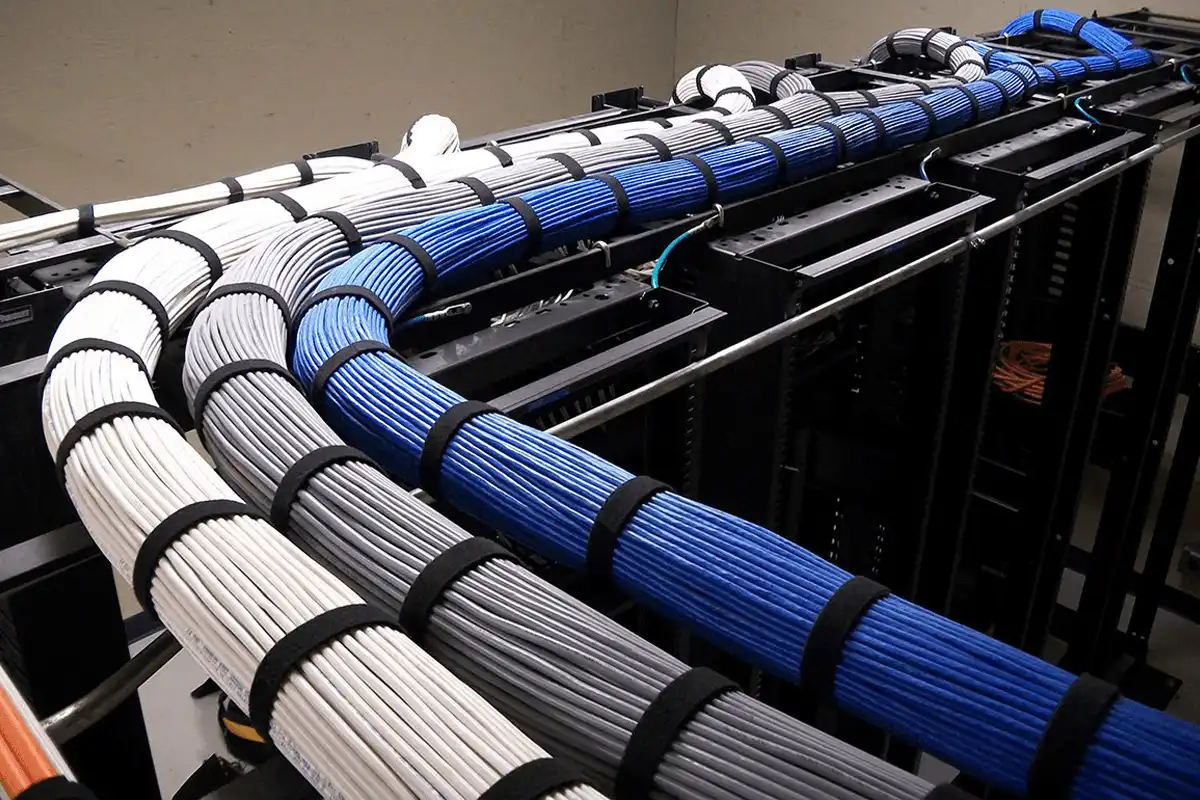
Physical Network Infrastructure

Every Cable Run, Tested and Labeled —
Built Right the First Time.

A network is only as reliable as the physical layer underneath it. Alpine IT installs Cat6 structured cabling, patch panels, and rack infrastructure that meets TIA-568 standards — with professional testing, clean labeling, and full documentation handed off when we're done.

Request a Consultation What We Install
The Foundation

Everything Runs on Cable. Cheap Cabling Causes Expensive Problems.

Wi-Fi speeds. Camera reliability. Access control response time. Every piece of technology in your building ultimately plugs into a physical cable somewhere. When that cable is run improperly — stapled around corners, maxed on length, untested, unlabeled — you inherit the problems permanently.

Intermittent connectivity. Speeds that don't match what your ISP delivers. Cameras that go offline randomly. Troubleshooting that can't isolate the issue because nobody knows which wire goes where. These are cabling problems masquerading as equipment problems.

Alpine IT installs cabling the way IT professionals expect to find it — properly routed, within spec, tested with professional equipment, and labeled so clearly that anyone can trace any run without calling us first.

TIA-568 Standards. All Alpine IT cabling installations follow TIA-568-D specifications — the commercial building telecommunications standard used by enterprise IT and required by most building codes for commercial wiring.

What Bad Cabling Looks Like
Cables stapled to baseboards around sharp corners — breaking internal pairs
Runs over 100m — outside Cat6 spec, causing intermittent drops
No patch panel — cables directly into switch, creating a tangled rats nest
Zero labeling — nobody knows which cable is which without tracing manually
Never tested — problems only discovered when something stops working
What Alpine IT Delivers
Properly routed in conduit or cable management — no sharp bends, no staples
Every run within 90m max (plus 10m patch) — inside TIA-568 spec
Patch panel terminations with cable management for clean, maintainable rack
Every port labeled at the wall plate and on the patch panel — matched
Every run tested — length, continuity, cross-talk, performance documented
Cat6 Standard Cable Grade
10Gbps Max Throughput (Cat6A)
100% Runs Tested & Certified
Full Documentation on Handoff
What We Install

From Individual Drops to Full Rack Buildouts.

Alpine IT handles every component of your physical network layer — from the cable run in the wall to the switch in the rack — as a complete, cohesive installation.

Cat6 Cable Runs

Industry-standard Cat6 horizontal cabling routed through walls, ceilings, conduit, or cable trays. Rated for 1Gbps at standard commercial runs and 10Gbps at shorter distances. Cat6A available for full 10Gbps to 100m.

Patch Panel Termination

All cable runs terminate at a patch panel in your network rack — not directly to switch ports. This creates a manageable, maintainable infrastructure that any technician can work with years from now.

Network Rack Buildout

Wall-mount or free-standing rack installation with proper cable management, patch panel, switch mounting, and power strip. Neat, accessible, and organized — not a pile of gear zip-tied to a shelf.

Wall Plate Installation

Professional keystone wall plates at every work area location — double-gang plates for multi-port drops, single-gang for individual locations. Matching the existing wall plate style wherever possible.

Professional Testing

Every run is tested with a professional cable certifier — verifying length, wire map, insertion loss, NEXT, and return loss. Failed runs are repaired and re-tested before handoff. No guessing, no assumptions.

📋

Labeling & Documentation

Every port labeled at the wall plate and patch panel with a matching ID. A full cable map documenting every run, port number, location, and length is provided on handoff — your permanent infrastructure record.

What's Included

A Complete Physical Infrastructure — Handed Off Clean.

On-site walkthrough — drop locations, routing paths, rack placement
Cable count and material estimate before work begins
Cat6 (or Cat6A) horizontal cable runs — in-wall, plenum, or conduit
Patch panel termination for all runs
Wall plate keystone installation at every drop location
Network rack or wall-mount enclosure installation (if needed)
Switch and equipment mounting in rack with cable management
Professional testing of every run — length, continuity, crosstalk
Labeling at both ends — wall plate and patch panel, matched and consistent
Complete cable documentation map handed off at project close
Related Services
Common Situations

Cabling Problems We Fix in Colorado Springs Businesses

These are the three most common reasons Colorado Springs business owners call Alpine IT about their physical network — and what we actually do about them.

Intermittent Drops
Proper Routing & Testing

Devices Randomly Lose Connection for No Obvious Reason

Intermittent drops are almost always a physical layer issue — a cable run over 100m, a sharp bend that cracked internal pairs, or a sloppy termination at the jack. Alpine IT certifies every run so these problems are caught before they become your problem.

Slow Speeds Despite Fast ISP
Cat6 Rated for Full Gigabit

You're Paying for Gigabit Internet but Getting a Fraction of It

Cat5e and incorrectly terminated Cat6 can't sustain the throughput a modern business needs. If your speeds at the wall jack don't match your ISP plan, the cable is the likely culprit. Every Alpine IT installation uses true Cat6 tested to spec.

No Documentation
Full Labeled Cable Map

Nobody Knows Which Cable Goes Where or What Anything Does

Inherited infrastructure without labels or documentation means every troubleshooting call costs more and takes longer. Alpine IT documents every run — port-to-port cable maps, labels at both ends — so any technician can trace any run in seconds.

Common Questions

Structured Cabling — Frequently Asked Questions

What type of cable does Alpine IT install?
Alpine IT installs Cat6 cable as the standard for new installations. Cat6 supports gigabit Ethernet and handles future bandwidth demands — it is what every new commercial build should use. Cat6A is available for deployments requiring full 10Gbps throughput to 100m, such as high-density AV or data center environments.
How do you route cables through an existing building?
Alpine IT runs cables through walls, ceilings, and conduit where required — using concealed routing wherever possible for a clean installation. We assess your space and plan all routing paths before any work begins, so there are no surprises mid-job. Drop ceilings, open ceilings, and finished drywall are all handled differently and quoted accordingly.
Is the cabling tested and documented at the end?
Yes. Every cable run is tested with a professional cable certifier — verifying length, wire map, insertion loss, NEXT, and return loss. Failed runs are repaired and re-tested before handoff. You receive a full documentation packet including a cable map with port numbers, locations, and test results for every run.
Do I need new cabling if I'm upgrading my network equipment?
Not always. Alpine IT will assess your existing infrastructure before recommending replacement. If your current cabling is Cat5e or better, properly terminated, and within spec length — it may support your upgrade without replacement. We test what's there and give you an honest answer rather than defaulting to a full recable.
Build It Right

Don't Inherit Somebody Else's Cabling Problems.

Whether you're moving into a new space, expanding an existing one, or cleaning up a mess left by a previous installer, Alpine IT will assess what you have and tell you exactly what needs to happen.

Get In Touch

Request a Consultation.

Tell us about your space and we'll schedule a walkthrough to assess your current infrastructure and scope out what the installation looks like.

Incorrect answer. Please try again.
Something went wrong. Please try again or call us at (720) 212-6657.